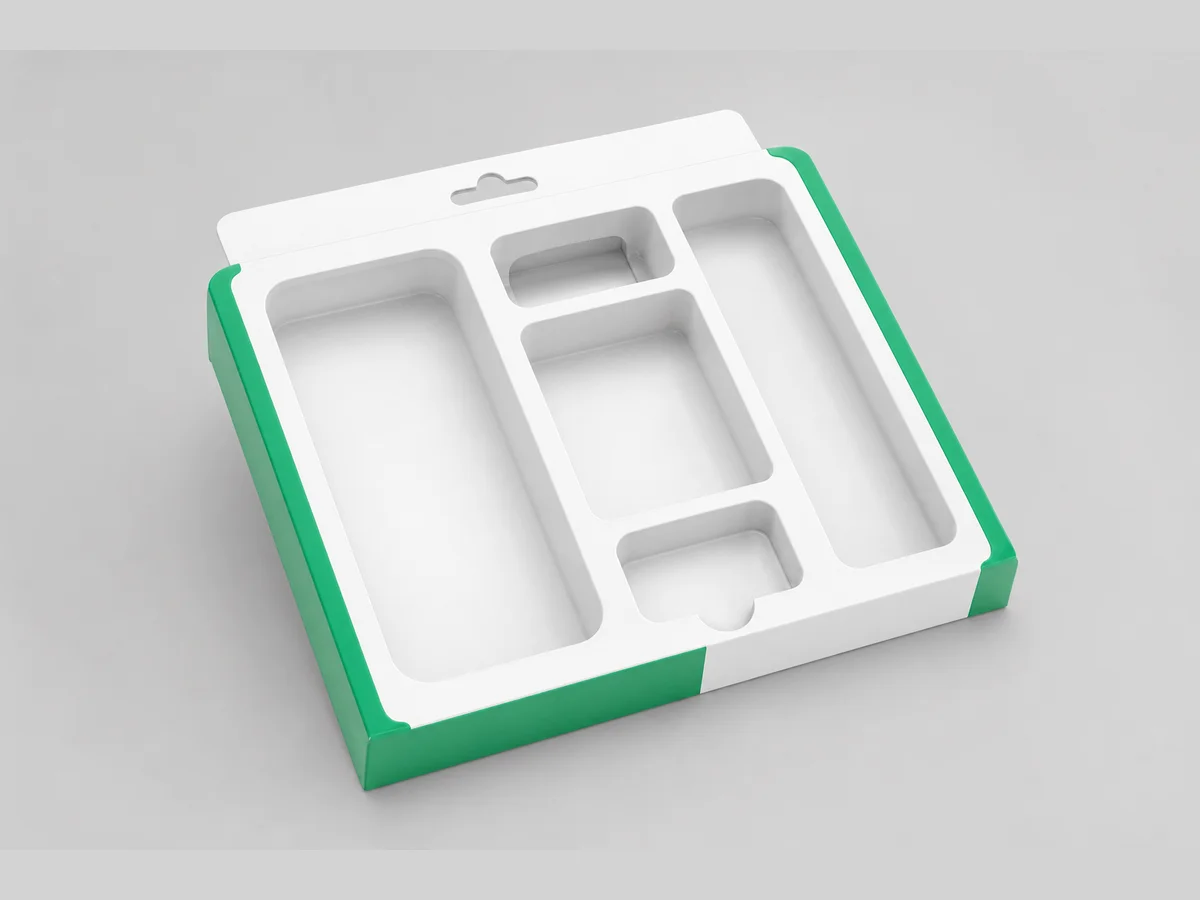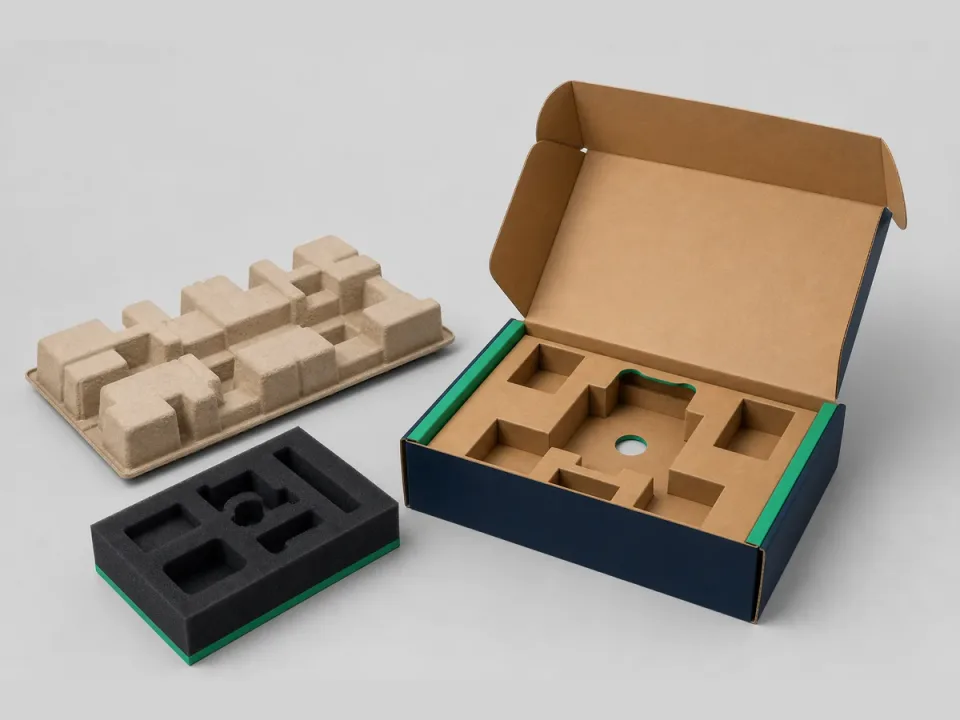
Custom foam inserts are the difference between a product that arrives and a product that arrives perfectly staged — cradled in a cavity cut to its exact shape. For electronics, glassware, instruments, cosmetics gift sets, and anything fragile, heavy, or irregular, foam is still the highest-performing interior protection available. BoxYourBrand produces end-to-end custom packaging for ecommerce and retail brands.
This guide covers foam types, how density and compression actually work, cavity tolerances, anti-static grades, the testing that validates a design, and when a paper-based alternative is the better call. For the full interior protection catalog, see custom inserts & void fill.
Foam types at a glance
| Foam | Structure | Feel | Best for | Notes |
|---|---|---|---|---|
| PE (polyethylene) | Closed-cell | Firm, resilient | Most products 1–50 lbs | Water-resistant; anti-static grades available |
| PU (polyurethane) | Open-cell | Soft, conforming | Optics, lightweight fragiles | Best surface protection; absorbs moisture |
| EVA | Closed-cell | Dense, premium | Presentation cases, tool kits | Takes color and lamination well |
| XLPE (cross-linked PE) | Fine closed-cell | Smooth, clean | Medical, high-end retail | Premium appearance, tight tolerances |
| Anti-static PE | Closed-cell | Firm | PCBs, components | Pink or black; dissipative surface treatment |
The open- versus closed-cell distinction drives most of the behavior. Closed-cell foams (PE, EVA, XLPE) do not absorb water, resist repeated compression, and hold a cut edge cleanly — which is why they dominate shipping inserts. Open-cell PU compresses more readily and conforms to delicate surfaces, but it absorbs moisture and takes a set faster under sustained load. Related formats include custom plastic packaging.
Density, compression, and why cushioning is not intuitive
The most common foam specification error is assuming denser foam protects better. It does not. Cushioning depends on static loading — the product’s weight divided by the foam’s bearing area — matched against the foam’s cushion curve. Use the quote wizard to compare quantity tiers side by side.
Put a light product on high-density foam and the foam barely deflects. Without deflection there is no energy absorption, so shock passes almost undiminished into the product. Put a heavy product on low-density foam and it compresses fully on the first impact, bottoming out and transmitting the remaining energy just as directly. Correct cushioning sits between those failures, where the foam deflects meaningfully without reaching full compression.
Three variables the designer controls:
- Density — typical PE packaging grades run roughly 1.2 to 2.2 lb/ft³. Higher density carries more load per square inch before bottoming out.
- Bearing area — the foam surface actually under the product. Reducing contact area raises static loading, which is sometimes exactly how you make a light product work with a stiffer grade.
- Thickness — deceleration distance. Thicker foam gives the product more room to slow down, which is why a thin pad of the perfect density still fails a drop test.
Compression set matters too. Foam that stays compressed under sustained load loses protective capacity, which shows up on long ocean transits and in warehouse stacking. Closed-cell PE and XLPE recover far better than open-cell PU under prolonged compression.
Die-cut vs CNC-routed inserts
Die-cut foam uses a steel-rule die to stamp cavities. It is economical from roughly 100–250 units, ideal for simple through-cuts, and the standard choice for production volume. Layered builds — a cavity layer glued over a solid base pad — cover most real-world jobs without routing cost.
CNC-routed foam carves stepped, variable-depth cavities with no die tooling. It is the right choice for complex geometry, low quantities, and prototypes, at higher per-unit cost.
On tolerances: die cutting typically holds about ±1/16“ (1.5 mm) on cavity dimensions; CNC routing holds closer to ±1/32“. In both cases, design the cavity slightly undersized relative to the product so the foam grips it. A cavity cut to exact product dimensions becomes a loose cavity after a handful of insertion cycles, and a product that moves inside its cavity is unprotected.
Two details that separate a good insert from a frustrating one: include a finger relief notch so the product can be lifted out without prying, and pay attention to draft on deep cavities — a perfectly vertical wall in thick foam makes insertion difficult on the packing line.
Anti-static grades for electronics
Standard foam generates static charge through friction, which is a real hazard for circuit boards, drives, and sensitive components. Three grade families exist, and the distinction matters:
- Anti-static (pink) — surface treatment prevents charge generation. The treatment is topical and degrades over months, which is fine for shipping and poor for long-term storage.
- Static-dissipative — controlled resistivity bleeds charge away slowly rather than in a damaging spike. The usual choice for boards and assemblies.
- Conductive (black) — lowest resistivity, used where the packaging is part of a grounded ESD-controlled process.
If your product has exposed contacts or unshielded electronics, specify the grade explicitly on your quote. Substituting standard PE because it was in stock is a common and expensive failure.
Testing before you commit to tooling
Foam is one of the few packaging components where a real drop test is worth the time, because failure is invisible until a customer opens the box. The recognized methods come from ASTM International — most notably ASTM D4169 for the overall distribution cycle and ASTM D642 for compression — and ISTA publishes parcel-focused test procedures that mirror how carriers actually handle packages.
You do not need a certified lab for a first pass. Pack the real product in the real box with the proposed insert and drop it corner-first, edge-first, and flat from about 30 inches onto a hard floor, which approximates parcel handling of a small package. Inspect for movement inside the cavity, foam bottoming, and any product damage. If a cheap in-house test fails, no amount of certification changes the outcome.
Order physical samples of the insert and its corrugated shipper together — testing an insert in the wrong box tells you nothing useful, because interior dimensions determine how much the insert can shift.
When foam beats cardboard — and when it doesn’t
Choose foam packaging when the product is fragile, heavy, high-value, has irregular geometry, or when presentation matters (watch cases, instrument kits, premium gift sets).
Choose cardboard dividers and inserts when cost, curbside recyclability, and flat shipping dominate — which is where most e-commerce programs land.
Paper-based alternatives worth evaluating:
| Alternative | Protection | Recyclability | Best for |
|---|---|---|---|
| Molded pulp | Good for moderate weights | Curbside recyclable | Electronics accessories, cosmetics |
| Corrugated inserts | Moderate, structure-dependent | Curbside recyclable | Multi-compartment kits, bottles |
| Honeycomb paper | Good compression resistance | Curbside recyclable | Heavier flat goods |
| Paper void fill | Fill only, not immobilization | Curbside recyclable | Gap filling around a protected item |
A common and sensible hybrid: corrugated or molded pulp across the e-commerce catalog, with foam reserved for the flagship SKU where damage cost or presentation justifies it.
Spec checklist before you quote
- Product dimensions and weight — the two inputs that drive density selection.
- Drop protection target — parcel networks need more cushion thickness than palletized freight.
- Static sensitivity — name the required grade (anti-static, dissipative, or conductive) rather than “anti-static foam.”
- Box pairing — order the insert and shipper together so interior dimensions match exactly.
- Presentation requirement — laminated or colored EVA for retail-facing; plain PE for pure transit protection.
- Storage duration — long warehouse holds favor closed-cell foam with low compression set.
Ordering foam inserts
Send product dimensions (or a physical sample) with your box spec and quantity to get a free quote. Die-cut programs start around 100–250 units. A cavity drawing and digital proof are approved before any cutting happens, and we recommend a physical sample round whenever the product is fragile or the geometry is complex.