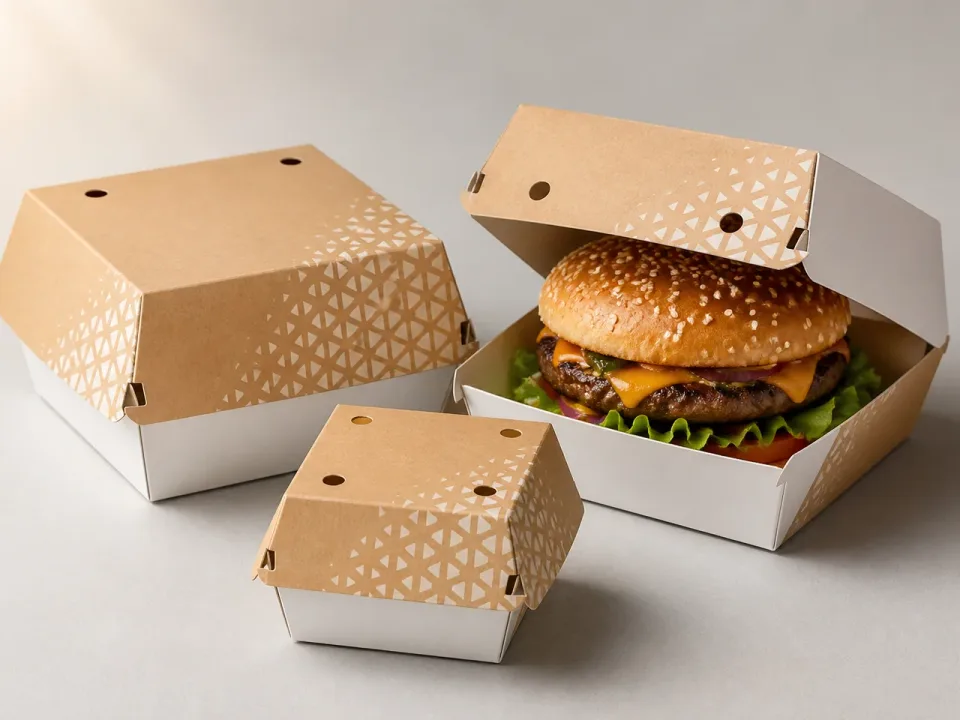
Burger box packaging has a harder job than most takeout formats — it must hold a hot, greasy, steam-producing sandwich through a 20–30 minute delivery leg without turning the bun soggy. Get size, venting, grease barrier, and structure right or customers blame your kitchen, not the courier. See custom burger boxes for dielines and food packaging for broader takeout programs.
This guide covers the four decisions that determine whether a burger arrives intact: size, venting, grease barrier, and structure for delivery.
Key takeaways
- Size burger boxes to assembled build height plus ~½“ headroom to prevent bun crush.
- Vent the lid to release steam — unvented boxes cause soggy-bun complaints on delivery.
- Grease-resistant, PFAS-free barriers keep oil off bags and couriers.
- Clamshells pack fastest; tuck-top cartons offer larger print panels.
Burger box sizes
Size is the decision most operators get wrong, and it goes wrong in both directions. Too tight and the lid compresses the bun crown and fuses cheese to the board. Too loose and the burger slides during transit, arriving off-center with toppings shed to one side. Browse food packaging for format specs and MOQ tiers.
Measure the assembled burger at its tallest point — with the crown on, not the components stacked loose — and add roughly half an inch of clearance. Related formats include pizza boxes.
| Box size (L × W × H) | Fits | Typical use |
|---|---|---|
| 4 × 4 × 3“ | Slider, 2–3 oz patty | Sliders, kids meals, catering |
| 5 × 5 × 3“ | Standard single, 4–5 oz patty | Most common SKU |
| 6 × 6 × 3“ | Double or loaded single | Smash doubles, bacon builds |
| 7 × 7 × 3.5“ | Triple or stacked build | Signature and LTO items |
| 8 × 6 × 3“ | Burger plus small fry portion | Combo box with divider |
Height matters more than footprint. Two boxes with the same base but a half-inch height difference produce noticeably different arrival quality on the same delivery route. Use the box size calculator to document internal dimensions before you request pricing.
Venting: the soggy-bun problem
A burger keeps releasing steam for several minutes after it is boxed. In a sealed box that steam has nowhere to go, so it condenses against the cooler lid and drips back down onto the bun crown. Ten minutes later the top bun is wet, and no amount of toasting on the line prevents it. Use the quote wizard to compare quantity tiers side by side.
Die-cut vents fix this, but placement matters:
- Upper third only. Vents low on the side wall sit in the grease pooling zone and leak oil into the bag.
- Lid and upper side walls. Cross-ventilation clears steam faster than lid holes alone.
- Away from print. A die cut through a logo looks like a defect. Reserve solid panels for artwork and vent the negative space.
- Scaled to the build. A slider box needs a fraction of the vent area a triple-stack box does.
The other half of the fix is keeping fries out of the burger box. Fries release far more steam than the burger, and a combo box without an internal divider is the fastest way to guarantee a wet bun. See our custom pizza boxes guide for the next decision in your workflow.
Grease barriers and food-contact rules
Uncoated paperboard will not hold back burger grease. Within about fifteen minutes, oil migrates through the board, the exterior goes translucent, and the pack feels unpleasant in the customer’s hand — a small detail that reads as low quality.
Food-grade board with a grease-resistant barrier coating is the baseline for any burger program. Moisture-barrier coatings are worth adding for sauce-heavy builds or humid climates.
The regulatory piece to know: grease barriers on food-contact paper were historically achieved with PFAS chemistry, and a growing number of US states now restrict intentionally added PFAS in food packaging. The FDA also maintains the food-contact substance framework that governs what can legally touch food. Practically, this means you should specify PFAS-free barriers and tell your supplier which states you operate in. Compliant alternatives are widely available and no longer carry a meaningful cost premium.
Board grades worth knowing:
- 18pt–24pt food-grade SBS — smoothest print surface, standard for brand-forward fast casual
- Kraft paperboard — natural look, pairs with soy inks and one- or two-color print
- E-flute food-grade corrugated — adds insulation and crush resistance for longer delivery legs
Structure for delivery and stacking
Most burger packaging complaints trace back to stacking rather than the box itself. Couriers load orders into insulated bags, and your lid carries the weight of whatever sits above it.
Three structural details decide how well a box handles that:
- Flat lids stack; domed lids do not. A slight dome to clear a tall build is fine, but a heavily domed lid becomes the crush point.
- Corner strength comes from the fold pattern. Corrugated clamshells outperform thin folding board when bags are loaded deep.
- Positive-close tabs beat friction tucks. A tab that clicks stays shut when a bag tips on a car seat.
Clamshell vs tuck-top
| Style | Advantage | Trade-off |
|---|---|---|
| Clamshell (hinged lid) | One-motion close, fastest at the pack station | Hinge fold interrupts lid print area |
| Tuck-top carton | Largest uninterrupted print panel, stacks well | One extra fold per pack |
| Corrugated clamshell | Best insulation and crush resistance | Higher board cost per unit |
| Window box | Product visibility for grab-and-go | Film complicates recyclability |
High-volume counters generally choose clamshells for speed. Brands where the box is a marketing asset — and especially those photographed on social — often accept the extra fold for tuck-top print area.
Sustainability without overclaiming
Recycled-content and compostable-friendly board are available on most burger formats, but claims need care. A box that is technically compostable only gets composted where industrial facilities accept food-soiled paper, which is a minority of US municipalities. Grease saturation also works against curbside recycling.
The defensible on-pack message is usually recycled content plus a plain recyclability note, not a blanket compostable claim. Our sustainable packaging hub and eco friendly packaging line cover materials and wording that hold up under the FTC’s environmental marketing guidance.
Print and brand placement
The lid is the panel customers photograph and the only one visible in a delivery bag, so design it first. Side walls carry sauce and allergen information where staff can read it without opening the box. The base is grease contact — keep it simple.
A QR code on the lid pointing to your own ordering page is the highest-leverage element you can print. For aggregator-heavy operations it converts app customers into direct ones at essentially zero marginal cost.
If you run limited-time items, keep the base dieline fixed and vary only the print. New artwork on an existing die costs a fraction of a new structure.
Ordering
Three inputs drive your quote more than anything else: weekly burger count, tallest build height, and whether you need a PFAS-free barrier (you almost certainly do). Send those with your artwork or a note that you need design support.
Digital-print runs start at 250 units. Meaningful price breaks land at 1,000 and 5,000. A single location serving 150 burgers a day burns roughly 4,500 boxes a month, so quarterly ordering at the 5,000-unit tier is typical once a concept stabilizes.
Request a free packaging quote for custom burger boxes, or order samples if you are changing board grade — grease performance is hard to judge from a spec sheet. Broader takeout programs can also browse food packaging.