Counter display boxes and floor displays both sell product at the point of purchase — but they win in different parts of the store. A counter unit captures impulse buys inches from the register; a floor display owns aisle presence for launches and high-SKU programs. Picking the wrong format wastes litho print budget, burns planogram slots, and leaves sell-through on the table. BoxYourBrand produces end-to-end custom packaging for ecommerce and retail brands.
This guide compares counter display boxes vs floor displays across cost, placement, materials, printing, sustainability, and buying decisions so CPG and retail brands can spec the right custom cardboard display boxes for each channel — or run both in the same campaign without reinventing the art.
What Is a Counter Display?
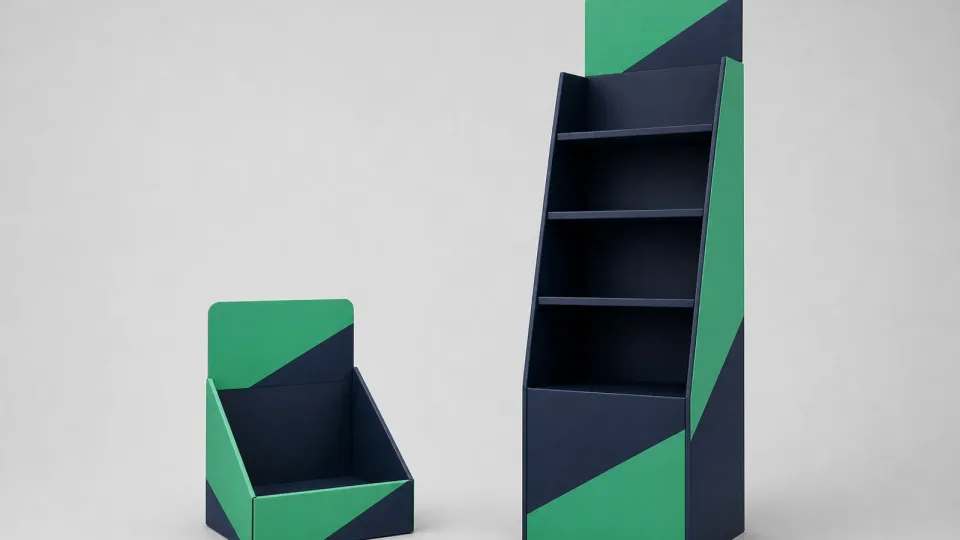
A counter display is a compact point-of-purchase (POP) unit designed for checkout lanes, pharmacy counters, convenience store registers, and other surfaces where footprint is tight and dwell time is short. Counter formats emphasize front-panel graphics and shallow depth so shoppers see the brand and reach for product in seconds. Related formats include custom plastic packaging.
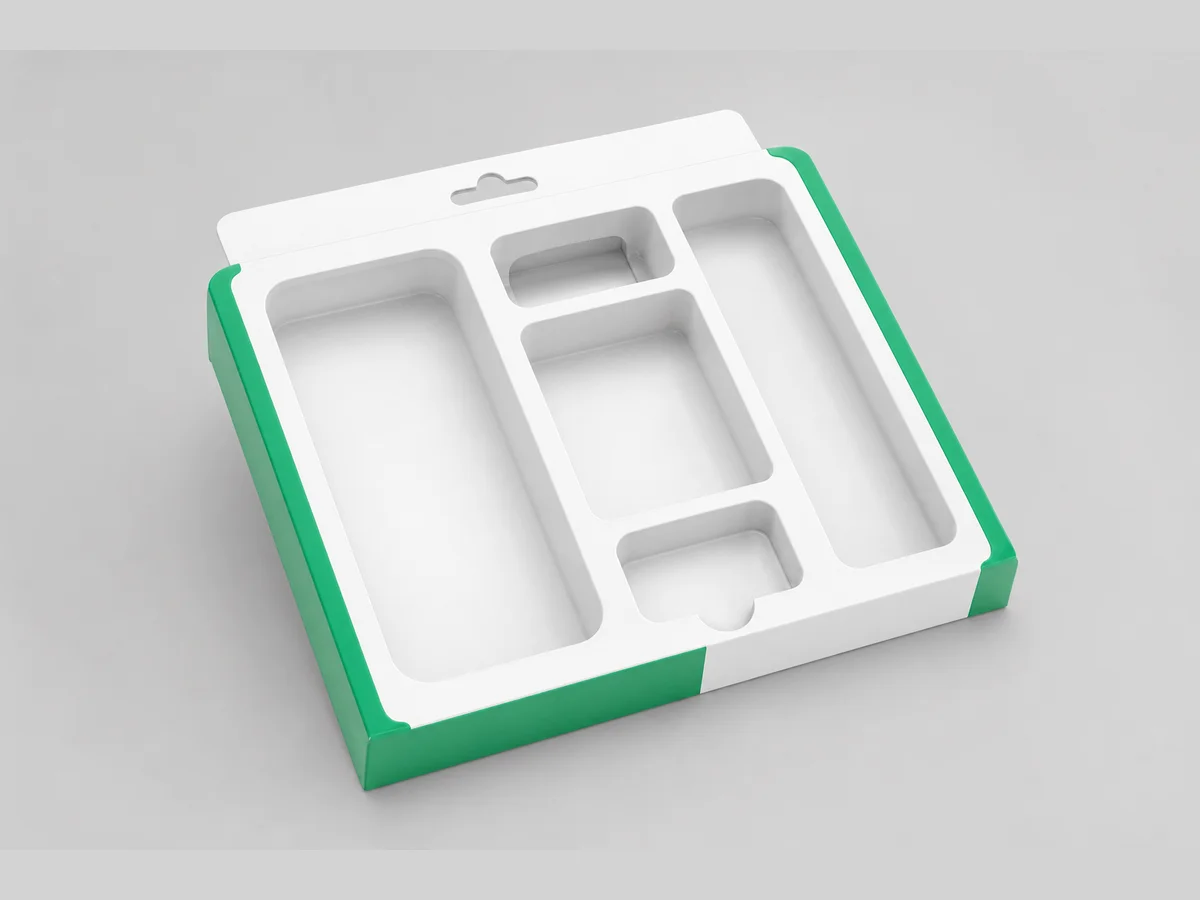
Custom retail display boxes in counter configuration typically use litho-laminated corrugated with a strong header or front face, open trays or dispenser openings for product access, and a base small enough to sit on a counter without blocking the transaction zone. Dispenser-style counter boxes — with a front tear strip or opening — suit categories where staff or customers pull units one at a time.
Typical counter display traits:
- Small footprint (width and depth constrained by counter space)
- Shallow product cavity; often 12–48 facings depending on SKU size
- Front-panel and header graphics prioritized over side panels
- Fast in-store assembly from flat-pack kits
- Best for impulse categories: snacks, candy, beauty minis, accessories, seasonal add-ons
Counter displays are not smaller floor units bolted to a register. They are engineered for a specific sightline — usually waist to chest height — and for retailers who measure compliance in inches, not aisle feet.
What Is a Floor Display?
A floor display is a freestanding POP structure placed in the aisle, at an endcap, or in a promotional bay. Floor units carry taller header cards, more shelf tiers, and higher total SKU capacity than counter formats. They are built for launches, seasonal programs, and categories that benefit from blocking aisle traffic and holding inventory on the sales floor.
Custom cardboard display boxes in floor format use the same litho-lam corrugated construction as counter units but scale up: multiple shelves, reinforced bases, larger header panels, and sometimes power wings or side wings for extra facing area. Floor displays ship flat-packed for freight efficiency and assemble in-store or at a distribution center.
Typical floor display traits:
- Freestanding; height often 3–5 feet including header
- Higher SKU count and deeper inventory per location
- Strong header and side-panel branding for aisle visibility
- Heavier board grades to support product load over weeks on floor
- Best for product launches, club and grocery rollouts, multi-SKU bundles
Floor displays cost more per unit in material, freight, and assembly labor — but one well-placed aisle unit can move volume that would require many counter locations to match.
Key Differences
Counter and floor displays share litho-lam corrugated construction and full-color print capability. The differences are footprint, shopper context, and total program economics.
| Factor | Counter display | Floor display |
|---|---|---|
| Placement | Checkout, pharmacy counter, register-adjacent | Aisle, endcap, promotional floor space |
| Footprint | Small base; shallow depth | Larger base; taller overall height |
| SKU capacity | Lower; impulse-oriented facings | Higher; multi-tier shelves common |
| Visibility | Front-panel dominant; short sightline | Header + sides; visible from aisle distance |
| Freight per unit | Lower cube; more units per pallet | Higher cube; fewer units per shipment |
| Assembly labor | Quick; often one person | More steps; may need two people or tools |
| Best for | Impulse, convenience, limited space | Launches, seasonal, high-volume categories |
| Planogram fit | Counter dimension specs | Bay width, height, and weight limits |
Neither format replaces shelf-ready packaging (SRP) — trays and SRP shippers live on the shelf. Counter and floor displays are additive POP tools that drive trial and visibility outside standard planogram bays.
Cost Comparison
Unit cost for POP display boxes depends on size, print coverage, board grade, and quantity — not on counter vs floor label alone. That said, floor displays almost always use more corrugated per unit, more litho laminate surface area, and a larger shipping cube than counter units in the same campaign.
BoxYourBrand retail display pricing follows volume tiers common across CPG rollouts:
- 50–249 units — promotion and pilot tier for regional tests
- 250–999 units — volume discount tier as programs scale
- 1,000+ units — national rollout pricing
Where counter displays save money:
- Less board and print area per unit
- Lower inbound freight per display (more units per pallet)
- Faster assembly reduces in-store labor
- Pilot quantities are affordable for convenience and pharmacy tests
Where floor displays justify higher cost:
- One aisle location replaces multiple counter placements for the same SKU count
- Header impact drives trial in high-traffic grocery and club aisles
- Seasonal and launch programs amortize tooling over large runs
Run the comparison on total program cost, not unit price alone. A $12 counter unit in 200 stores may underperform a $45 floor display in 40 high-volume locations — or the reverse for a low-velocity SKU. Match format to sell-through data and retailer door count.
Best Use Cases
When to choose a counter display
Counter units win when the shopper is already in buying mode and the product is an add-on or impulse pick.
Strong counter use cases:
- Convenience store checkout lanes (beverages, snacks, candy, phone accessories)
- Pharmacy and health counters (travel sizes, seasonal wellness, beauty minis)
- Category aisles with dedicated counter space (beauty testers, gift cards adjacent)
- Low cube, high-margin items that do not need aisle blocking
- Regional pilots before committing to national floor tooling
Brands in retail and CPG often pair counter displays with dispenser boxes for categories that need controlled product pull.
When to choose a floor display
Floor units win when the brand needs aisle presence, inventory depth, or launch impact.
Strong floor use cases:
- New product launches requiring header storytelling and multi-SKU facings
- Seasonal programs (holidays, back-to-school, summer) with 4–8 week floor life
- Grocery and club aisles where endcaps and promotional bays are available
- Bundles and variety packs that will not fit a counter footprint
- Categories where competitors already own floor space and you need parity
When to use both
National CPG brands frequently run counter units for convenience and pharmacy doors and floor displays for grocery and club launches in the same campaign art family. Shared litho plates and color standards across formats cut design cost while tailoring structure to each retail environment.
Retail Placement
Placement rules vary by retailer, but the logic is consistent: counter displays belong where transactions happen; floor displays belong where traffic flows.
Counter placement zones:
- Checkout lane cap displays and queue-line units
- Pharmacy consultation counters and pick-up areas
- Register-adjacent fixtures in convenience and specialty retail
- Category-owned counters (cosmetics, electronics accessories)
Floor placement zones:
- Main aisle promotional bays and temporary floor stacks
- Endcaps at category entrances
- Seasonal aisles and cross-merchandising zones
- Club store pallet-adjacent displays (where retailer specs allow cardboard POP)
Every placement must pass planogram compliance — width, depth, height, and sometimes weight limits per bay. Retailers publish dimension and graphic rules; share your target account list when quoting so engineering matches their checklist. Read our shelf-ready cardboard displays planogram guide for SRP and tray compliance basics that often run alongside POP programs.
Poor placement kills good creative. A stunning header card hidden below sightline or a counter unit that blocks the card reader will be pulled regardless of print quality.
Material Comparison
Both counter and floor displays are built from litho-laminated corrugated engineered for retail presentation — not plain transit cartons. BoxYourBrand retail display specs include E-flute and B-flute options and white-top board for high-graphic panels.
Counter display materials:
- Lighter flute grades often suffice for shallow loads and short dwell times
- Reinforced base tabs and locking slots for register vibration
- Litho laminate on front and header; sides may be lower-coverage to save cost
Floor display materials:
- Heavier B-flute or reinforced structures for multi-tier loads
- Stiffer bases and internal supports to prevent racking in high-traffic aisles
- Full-panel litho on header, front, and sides for 360° aisle visibility
Material choice ties to total product weight and expected weeks on floor. A two-week convenience counter pilot can use a lighter spec than a six-week grocery floor program holding 80 units. Weak trays collapse, facings sag, and retailers delist the SKU — match flute grade and laminate to load in the dieline review.
For a broader substrate overview beyond displays, see our custom packaging materials guide.
Printing Options
Retail displays are print-forward packages. BoxYourBrand custom retail display boxes support litho-laminate full-color CMYK, high-graphic flexo, and spot UV accents on logos and callouts.
Litho-laminate full-color — the default for photographic headers, flavor cues, and campaign art. Counter and floor displays in the same program should share color standards and plate sets where panel sizes allow.
High-graphic flexo — cost-efficient at very high volumes on simpler graphics; confirm match to litho proofs if mixing formats.
Spot UV accents — draw the eye to logo or promo callout without full-panel laminate on every surface.
Apply the same header hierarchy principles from POP display design for impulse sales: one primary benefit claim, high contrast against aisle lighting, and product visibility through open trays or window cutouts. Floor headers have more vertical space; counter units must communicate in a narrower band — design for each format, do not shrink floor art onto a counter panel.
Coordinate barcodes, case labels, and inner tray marks during dieline review so outer shippers and display units scan correctly at retail.
Sustainable Display Packaging
Cardboard POP displays are predominantly fiber-based — and corrugated and paperboard are recyclable when free of food residue and non-paper attachments, including most retail display formats. That positions litho-lam corrugated displays favorably versus mixed-material permanent fixtures for brands reporting recyclability to retailers.
Sustainable display practices:
- Specify recycled content board where retailer scorecards require it; explore eco-friendly packaging options during quoting
- Use soy-based or water-based inks when brand story and retailer audits favor lower-VOC print
- Avoid over-specifying heavy laminates or mixed-material windows that complicate municipal recycling
- Print a small material legend on the base panel so store staff and customers know the unit is corrugated-recyclable
Sustainability does not mean dull graphics. Kraft and recycled board with strong soy-ink color perform well on counter units targeting natural and wellness categories. Read the full sustainability hub for material labeling and honest recyclability messaging.
Floor displays use more fiber per unit — right-sizing structure (no oversize headers, no redundant internal walls) reduces material per sell-through dollar.
Design Tips
Strong display creative balances marketing impact with stocking reality.
Header and front-panel hierarchy — Lead with logo and one benefit claim. Counter units have less vertical space; floor units can support a secondary line of copy on the header extension.
Product visibility — Open trays, angled shelves, and die-cut windows increase trial. Balance visibility with shrink risk based on category norms and retailer guidance.
Assembly clarity — Complex displays fail in store when instructions are unclear. Spec glue tabs, locking slots, finger holes, tear strips, and numbered assembly icons during engineering review. Retailers favor displays that cut back-room time; see custom cardboard display boxes for retail for stocking-labor considerations.
Durability for dwell time — Match flute and base design to weeks on floor, not just day-one photography.
Pilot before national print — Validate one market with a short-run counter or floor unit before committing to full litho plate investment. Adjust header copy and color based on sell-through data.
Campaign consistency — When running counter and floor formats together, lock color standards and logo placement so the brand reads identically across touchpoints.
Buying Guide
Use this sequence when specing counter display boxes vs floor displays for a new or expanded retail program.
- List target retailers and placement types — checkout counter, pharmacy, aisle endcap, promotional bay. Each may have different dimension limits.
- Define SKU count and product weight per display — determines shelf tiers, flute grade, and base reinforcement.
- Choose format — counter for impulse and tight footprint; floor for launch impact and inventory depth; both for split-channel rollouts.
- Share planogram or retailer spec sheets — engineering sizes the dieline to compliance before art is finalized.
- Align print and finishing — litho-lam CMYK, spot UV, flexo at volume; approve digital proof before plates run.
- Order samples — request samples to validate assembly, color, and structural fit before production.
- Quote volume tier — pilot at 50–249 units, scale to 250–999 and 1,000+ as sell-through proves out.
Standard production turnaround is 8–12 business days after proof approval; 3–5 business day rush is available when timelines compress. Displays ship flat-packed for efficient freight and in-store assembly unless pre-assembled delivery is required.
Get a free display box quote with your retailer list, dimensions, and SKU count. A packaging specialist can recommend counter vs floor structure and board grade for your program.
Counter display boxes vs floor displays is not a permanent either-or. It is a decision about shopper moment, retailer placement, SKU depth, and program economics — and getting it right improves sell-through on every door in your rollout. When you are ready to spec, explore custom retail display boxes and request a quote with your placement list and volume targets.
Browse dispenser boxes when you are ready to spec sizes, print, and MOQ for this format.